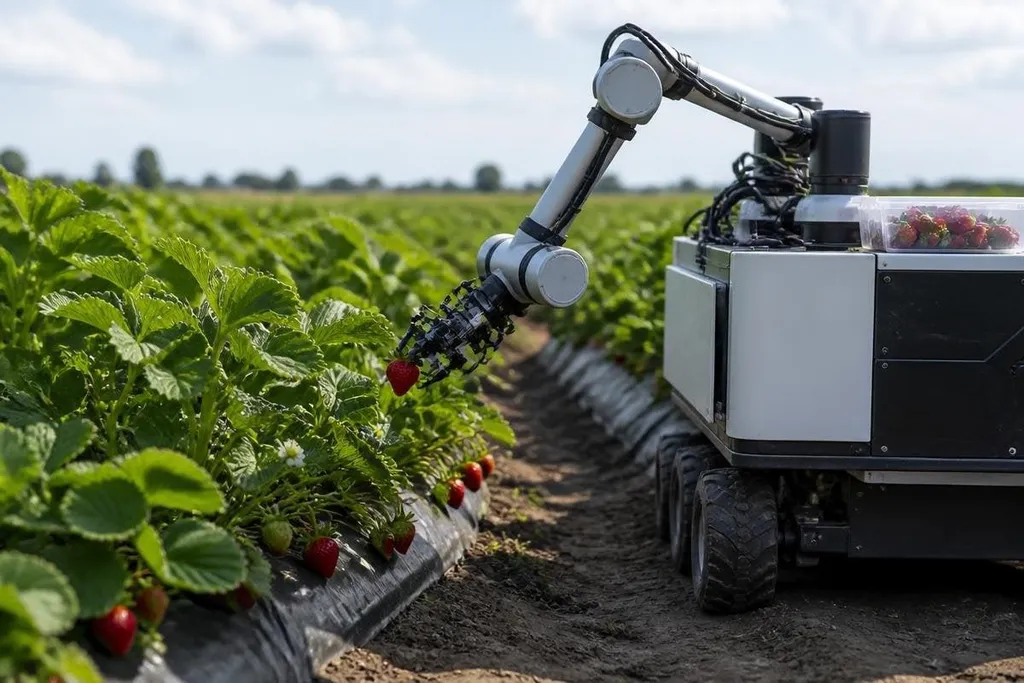
A harvesting robot has to find ripe produce, reach it without damage, and place it in a container. That sounds like one task, but it joins sensing, movement, gripping, and farm planning in a single machine.
The hard part is making many small decisions work together across changing fields, from spotting ripe produce to placing it safely in a container.
- Ripe produce changes the task: color, size, and position can vary on the same plant.
- Gentle handling matters: a robot can pick the crop and still ruin it with too much force.
- Field work is uneven: mud, leaves, sunlight, and plant shape all affect robot movement.
The robot has to see the crop first
A harvesting robot needs cameras or other sensors to find fruit among leaves and branches. Its software then estimates which items are ready and where a gripper can reach them.
That decision is harder than it looks. Produce may be partly hidden, close to another item, or lit from behind. A robot that mistakes an unripe item for a ripe one can lower the quality of the crop, while a missed item may stay on the plant until the next pass.
The sensor also has to work as the robot moves. Shadows shift across the plant, leaves move in the wind, and the camera may see the same fruit from a new angle. The system needs a fresh estimate before the arm moves, not a fixed picture from the start of the row.
The gripper has to handle many shapes
Finding the crop is only half the job. The end effector, which is the tool at the end of the arm, must hold the item firmly enough to remove it without bruising the skin, tearing the plant, or dropping the crop.
A tomato, apple, cucumber, and berry do not give a robot the same contact points. Some crops need a cut. Others need a twist, pull, or support from below.
The robot must sense contact and change its force when the plant resists. That makes the gripper a direct link between robot speed and crop quality. A fast arm that damages produce creates extra sorting work, so the useful measure is picked produce that still meets the buyer's standard.
Movement changes from field to field
Farm rows can be uneven, narrow, wet, or crowded with leaves. A mobile robot needs to keep its body stable while the arm reaches into the plant, and it needs to stop when a person, animal, tool, or unexpected obstacle enters its path.
The arm also has a limited reach. If the robot cannot reach the upper or inner part of a plant, a second pass may be needed. That adds travel, battery use, and time for each harvested item.
These limits make field layout part of the robot design. A system built for orderly rows may need different wheels, sensors, or arm motion for a field with wider plants and less space between them.
Row spacing can change a harvesting robot’s reach, turning a quoted picking rate into a field-specific number. Harvesting robotics reporting from Robot24.com can tie each result to the crop, test date, picking rate, and human work left after a fault. That gives the next section a clear job: separate a working field test from a promising demo.
What still needs proof
A demonstration can show a robot picking one item. Farm use needs a longer record across changing plants, weather, crop quality, and work shifts. Those results need clear measures, such as how many items the robot picks, how much it damages, and how often a person must step in.
The price also matters. A farm may need the robot, charging gear, software, repairs, and a way to move full containers. A machine that works in a test row may still cost too much if it needs frequent human help or covers too little ground.
I’d judge a harvesting robot by saleable produce per hour, not by how smooth the demo looks.
A practical buying checklist
Use these questions before treating a harvesting robot as a working farm tool:
- Crop fit: Which crop and plant variety has the robot handled?
- Picking record: How many items did it pick during a full work period?
- Damage rate: How much produce needed sorting after the robot touched it?
- Human help: What tasks still need a worker beside the robot?
- Field limits: Which row widths, slopes, light levels, and ground conditions does it support?
- Running cost: What do the robot, service plan, charging equipment, and replacement parts cost?
A better harvesting robot will need more than a good arm or a clear camera view. It must keep making sound choices when the plant, light, ground, and crop quality change. Until makers publish those field results and full operating costs, the race remains a test of proof rather than a contest of polished demonstrations.